The idealized picture of an interface between two elemental materials is simply an abrupt transition between planes containing two different types of atoms. In practice, atoms of one species always diffuse into the other, but transport models usually ignore this fact. The IRG investigators, with collaborators from Oak Ridge National Lab have shown how interdiffusion has a profound effect on spin-polarized transport for certain pairs of normal metals and ferromagnets: those which form Kondo systems. In this case, spin transport is modified by “clouds” of electrons that from around magnetic impurities in the normal metal. This explains an anomalous reduction in the spin signal at low temperatures observed by many groups in spin valves based on Fe-containing alloys.
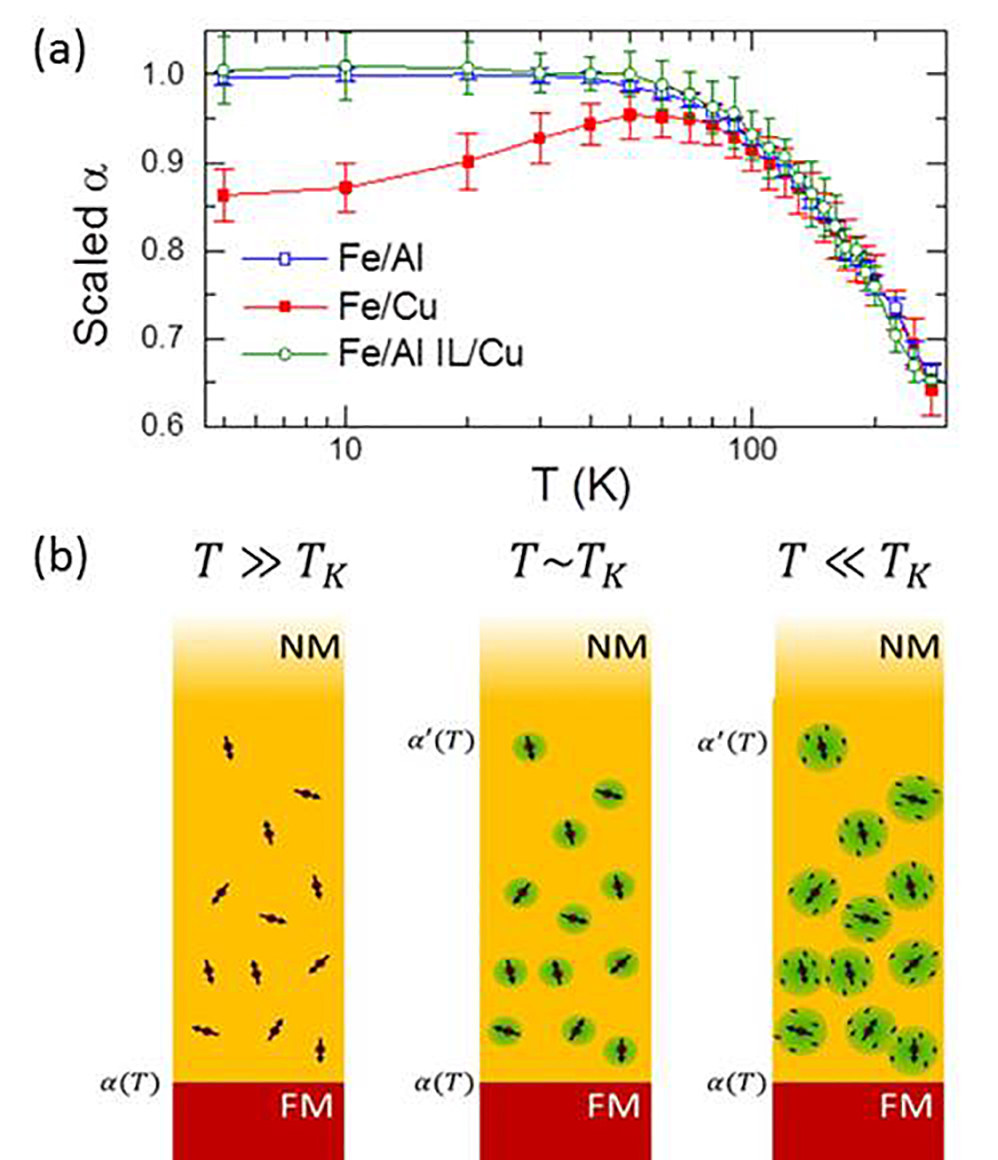

(a) The non-local resistance anomaly observed in Fe/Cu spin valves (red points), in which the polarization of the current decreases with decreasing temperature.  The effect does not occur in Fe/Al (blue)or in Fe/Cu devices with Al interlayers.  (b)  The effect is due to the formation of a screening cloud around local moments (the Kondo effect).  The effect saturates at low temperature, but the polarization of the current is reduced below its ideal value.
(a) The non-local resistance anomaly observed in Fe/Cu spin valves (red points), in which the polarization of the current decreases with decreasing temperature. The effect does not occur in Fe/Al (blue)or in Fe/Cu devices with Al interlayers. (b) The effect is due to the formation of a screening cloud around local moments (the Kondo effect). The effect saturates at low temperature, but the polarization of the current is reduced below its ideal value.