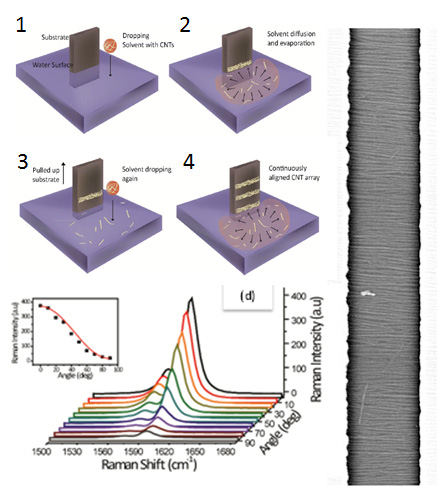
 Creating aligned arrays of high purity (>99.9%) semiconducting single-walled carbon nanotubes (s-SWCNTs) over a large area has been a significant challenge in materials synthesis. Towards this goal, IRG2 have recently developed a novel yet simple method to deposit aligned s-SWCNTs on substrates via dose-controlled, floating evaporative self-assembly. The diffusion of organic solvent at the water-air interface results in the deposition aligned s-SWCNTs on a partially submerged hydrophobic substrate, which is withdrawn vertically from the surface of water, hence gaining complete control over where the stripes are deposited and the quantity of s-SWCNTs deposited. Polarized Raman studies have shown that the s-SWCNTs are aligned within ±14º, are packed at a density of 50 s-SWCNTs µm-1.
The result is the rapid deposition of s-SWCNTs into aligned arrays that can be adapted for scalable integration into a wide variety of microelectronic applications. Already field-effect transistor (FET) devices show high performance with a mobility of 38 cm2 V-1 s-1 and on-off ratio of 2.2 × 10⁶ at a channel length of 9 μm.

Wisconsin Materials Research Science and Engineering Center
The U.S. National Science Foundation-sponsored Wisconsin Materials Research Science and Engineering Center brings together teams of researchers from diverse disciplinary backgrounds to tackle grand challenges in the materials science of liquids and glasses and non-equilibrium magnetism.