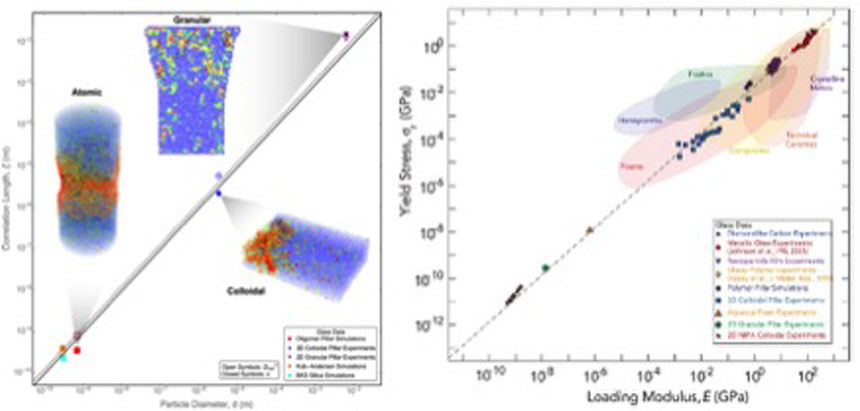
A metal spoon can bend in half without breaking because of defects in its crystalline structure. By contrast, a metal spoon with atoms in a disordered structure—a metallic glass spoon—would break via a catastrophic brittle fracture. Here we show that disordered packings of particles ranging in size from atoms, as in a metallic glass, to nanoparticles to micron-sized colloids to centimeter-sized granular particles, show universal behavior in their microscopic structure and dynamics and in their macroscopic mechanical response, even for systems with extremely different interactions between particles. We calculate the length scale for correlations of softness that quantifies the size of microscopic rearrangements, as well as a particle’s propensity to rearrange. Both quantities are of the order of the particle diameter for all systems studied (top figure). We then measure the yield stress, which marks the onset of mechanical failure, as a function of loading modulus for all systems studied (bottom figure). All of the disordered packings fall on the same line, showing that the size of rearrangements and of structural defects controlling them, in units of the particle diameter, and the yield strain have universal values. Thus studies of colloids and grains give useful quantitative insight into mechanical failure of atomic or molecular glasses.
 Download

UPENN Materials Research Science and Engineering Centers
The LRSM at UPENN is a center of excellence for materials research and education. It facilitates collaboration between researchers from different disciplines including physics, chemistry, engineering, and biology to advance transformative scientific projects and solve societal challenges.