In Through the Looking Glass, Alice steps through a mirror into a world in which everything is its mirror image. Realizing that writing in books is reversed, Alice wonders what has happened on the atomic scale. “Perhaps Looking-glass milk isn't good to drink?,” she says to her cat.
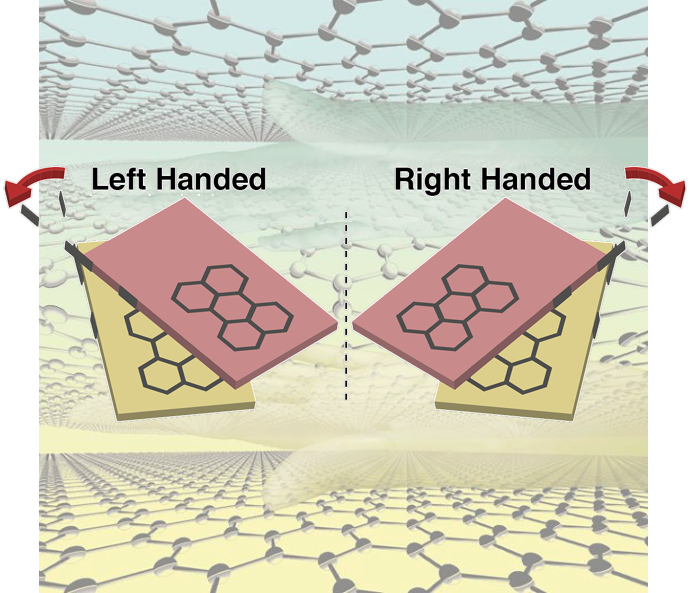
Using a material only two atoms thick, researchers at Cornell University and colleagues from Instituto de Física UNAM, Mexico have confirmed Alice’s suspicion that mirror-image materials are different. The researchers stacked two sheets of carbon atoms, each a single atom thick, with a precise left-handed twist. They then stacked two more sheets with a precise right-handed twist. As shown in the figure, these two stacks are mirror images of one another. The researchers showed that light behaves differently when passing through the two materials; the films showed remarkably large “circular dichroism.” In the future, these handed or “chiral” thin films may enable the production of ultrathin devices with advanced chiral functionalities.
 Download