Navier-Stokes equations dictate that the conventional fluid flows only in response to an externally imposed gradient in stress or a body force. We developed a novel active fluid that is comprised of microtubules and energy consuming molecular motors kinesin. We demonstrate that upon confinement, such active fluids undergo an inherently non-equilibrium transition from local chaotic flows to globally coherent flows that have long range order and are capable of transporting matter on macroscopic (meter) lengthscales. Our work uncovers a simple scale invariant criterion that predicts the location of the transition to coherent flows, and demonstrates that the formation of coherent flow is accompanied by the formation of a nematic layer that wets the confining boundaries at a specific oblique angle.

- Wu et. al, Science, 355, eaal1979 (2017)
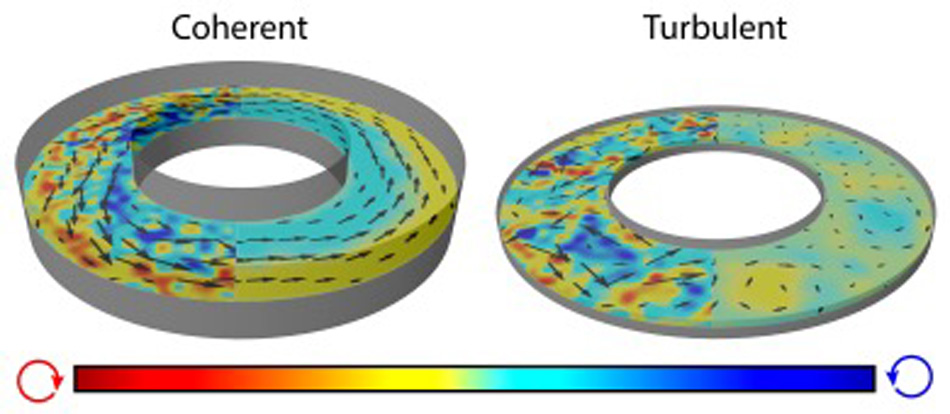
Increasing the height of the annulus induces a transition from locally-turbulent to globally-coherent flows of a confined active isotropic fluid. The left and right half-plane of each annulus illustrate the instantaneous and time-averaged flow and vorticity map of the self-organized flows. The transition to coherent flows is an intrinsically 3D phenomenon that is controlled by the aspect ratio of the channel cross-section, and vanishes for channels that are either too shallow or too thin.