Large-area growth of monolayer films of transition metal dichalcogenides is important in the rapidly advancing research field of topological materials, because scientists believe tungsten ditelluride has so-called “topological” electronic states. To this end, the Penn MRSEC SuperSeed team (Rappe, Johnson) and IRG faculty (Carpick, IRG-3; Kikkawa, IRG-4) collaborated to develop a growth process methodology for synthesis of reliable and reproducible large-area many-monolayer 1T'-WTe2 flakes.
This work takes critical steps towards making continuous films with controllable topological currents. In multilayer form, 1T'-WTe2, is a particularly exciting material. It is believed to possess a large non-saturating magnetoresistance (an extra electrical resistance induced by applied magnetic fields), as well as pressure-induceable superconductivity. Because this material has multiple exotic properties, it could also have implications in quantum computing.
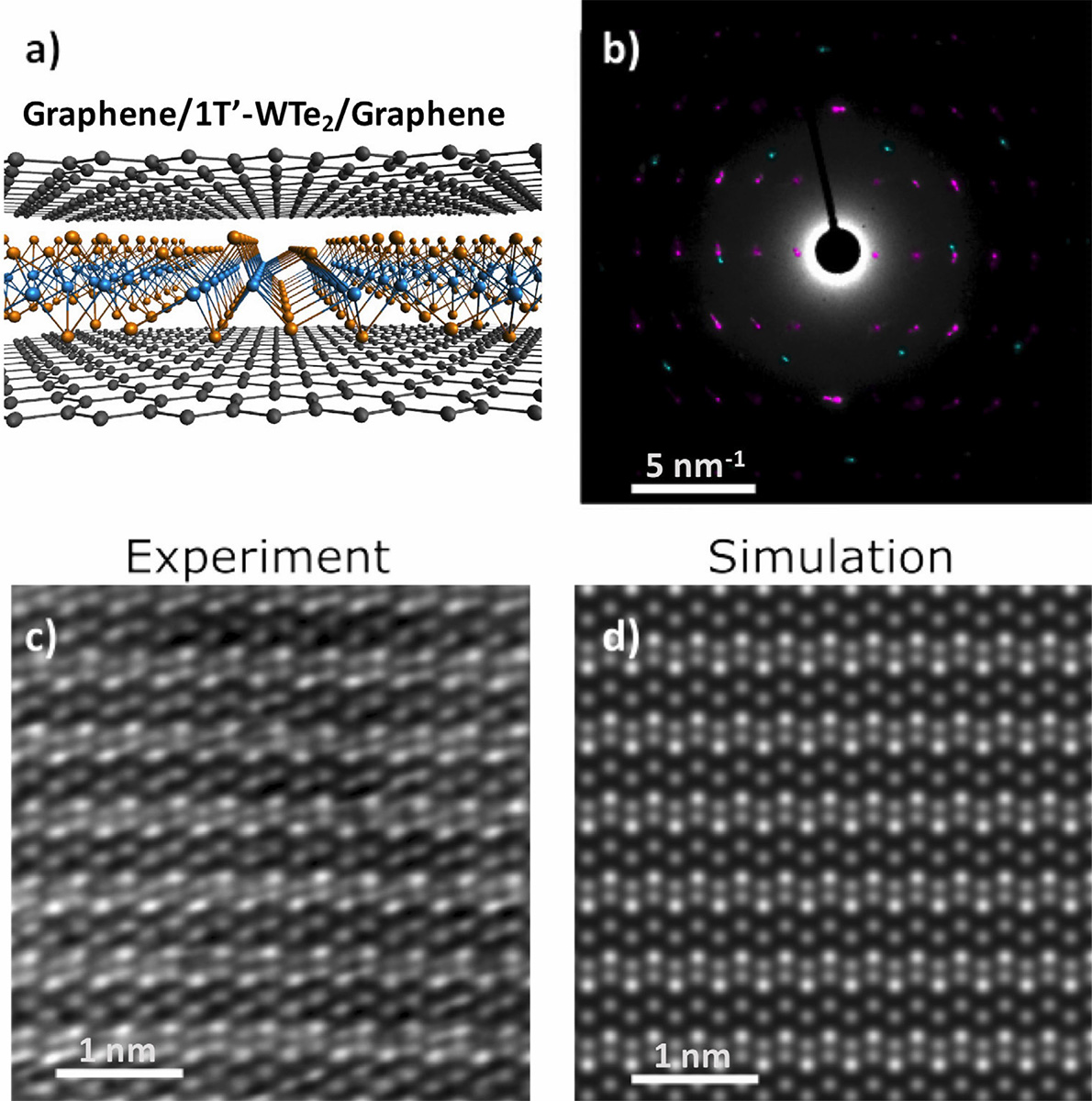
The team confirmed the composition and structure of monolayer 1T'-WTe2 flakes using x-ray photoelectron spectroscopy, energy-dispersive x-ray spectroscopy, atomic force microscopy, Raman spectroscopy and aberration corrected transmission electron microscopy (see Figures).
C.H. Naylor, W.M. Parkin, Z. Gao, H. Kang, M. Noyan, R. BWexler, L.Z. Tan, Y. Kim, C.E. Kehayias, F. Streller, Y.R. Zhou1, R. Carpick, Z. Luo, Y. Park, A.M. Rappe, M. Drndić, J.M. Kikkawa, A.T. Johnson, 2D Mater. 4 , 2017
 Download

UPENN Materials Research Science and Engineering Centers
The LRSM at UPENN is a center of excellence for materials research and education. It facilitates collaboration between researchers from different disciplines including physics, chemistry, engineering, and biology to advance transformative scientific projects and solve societal challenges.