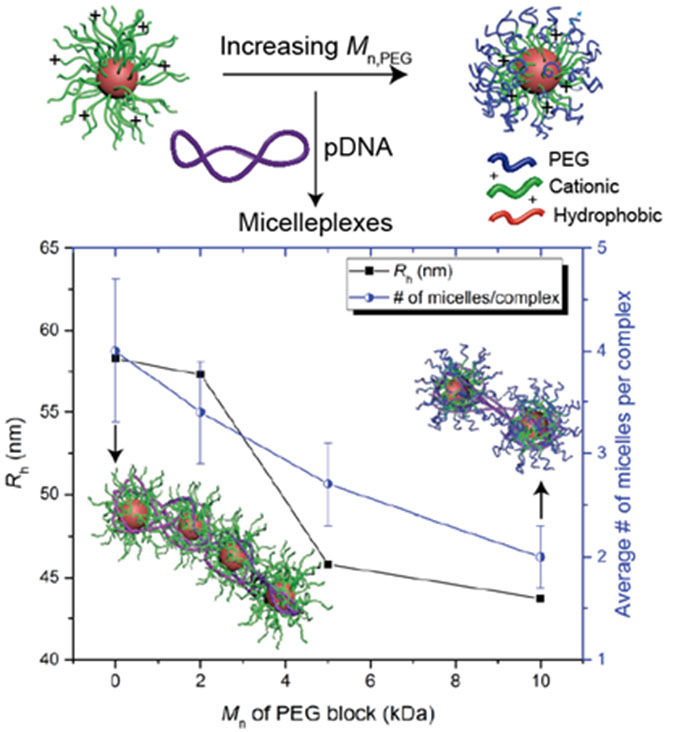
The versatility of polyelectrolyte complexes resides in the facile incorporation of multiple chemical components in the composing polyions, which allows design of complexes with intricate structures and multiple functionalities. In this work, the complexation of ABC micelles with a model semiflexible polyion, DNA, is systematically investigated to correlate the structure of the micelle with the properties of the resulting “micelleplexes”. With the addition of a nonionic outer corona, the colloidal stability of the resulting micelleplexes dramatically improves and is maintained over a wide range of charge ratios. At the same time, the size, composition and structure of micelleplexes can be tuned by varying the nonionic outer corona length without compromising the colloidal stability. These results demonstrate a new strategy to compact long chain polyions and design nanoparticles with superior colloidal stability and tunable composition.
 Download