We describe hierarchical assemblages of colloidal rods that mimic some of the complexity and reconfigurability of biological structures. In particular, we show that chiral rod-like inclusions dissolved in an achiral colloidal membrane assemble into rafts, which are adaptable finite-sized liquid droplets that exhibit two distinct chiral states of opposite handedness. Interconverting between these two states switches the membrane-mediated raft interactions between long-ranged repulsions and attractions. Rafts with switchable interactions assemble into analogs of electrostatic complexation observed in charged particulate matter. A simple theoretical model explains these experimental findings. Our synergistic theoretical and experimental efforts results demonstrate a novel and highly robust pathway for self-assembly of reconfigurable colloidal superstructures, that does not depend on tuning the shape and interactions of the elemental units, but rather on the complexity of the emergent and still poorly understood membrane-mediated interactions.
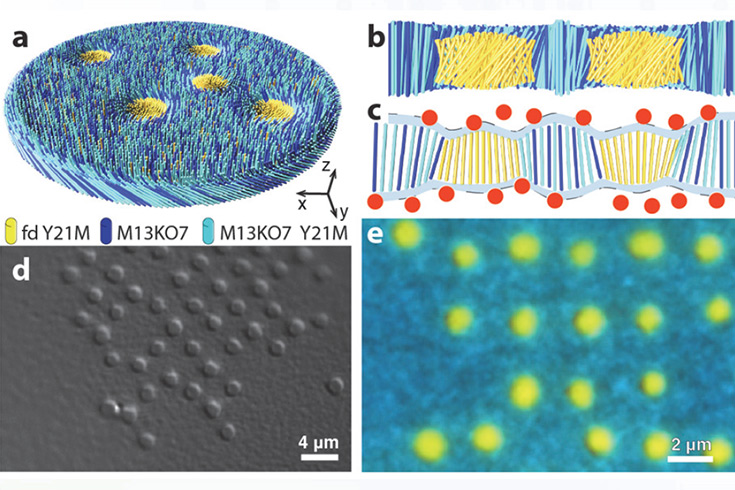
Colloidal rafts with switchable attractive and repulsive interaction. (top) Schematic and (bottom) optical microscopy images of colloidal rafts that assemble in membranes that have no net chirality. Differential interference microscopy (left) and fluorescence images (right) of colloidal rafts that assemble into crystalline lattices with unusual square symmetry. Such assemblages can be understood by measuring the effective membrane-mediated raft-raft interactions that can switch between repulsions and attractions and which are regulated by the raft chirality.