DNA origami technology is used to develop building blocks that self-assemble into predetermined finite-sized structures. The objectives of this research are to understand, control, and build self-closing structures inspired by self-assembling viruses, whose smallest capsids have an icosahedral symmetry and are decomposable into so-called “quasi-equivalent” triangular subunit arrangements, characterized by the “T” number (Fig. 1A). Assembly occurs using programmed edge-edge interactions based on a lock-and-key mechanism and base stacking between the blunt ends of the double-helices. Researchers have successfully designed, assembled and characterized capsids of octahedral and icosahedral symmetry, including T1, T3, T4, and T9, and studied the determinants of capsid assembly experimentally and with a direct comparison to a computational model to test how the kinetics and yield of target structures depends on control parameters and assembly pathways (Fig. 1).
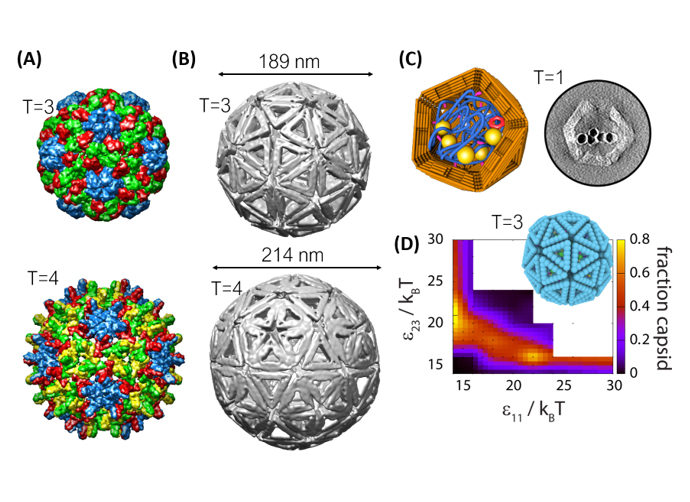
(A) Structures of icosahedral virus capsids, where T is the number of distinct local symmetry environments (indicated by color). (B) Cryo-electron microscopy reconstructions of DNA origami capsids. (C) (right) TEM tomogram of an origami capsid assembled around a DNA molecule labeled with gold nanoparticles. (left) Schematic of the structure. (D) Prediction of the yield T=3 capsid yield as a function of subunit-subunit interaction strengths that drive dimer formation (e11) and pentamer formation (e23), from Langevin Dynamic simulations.