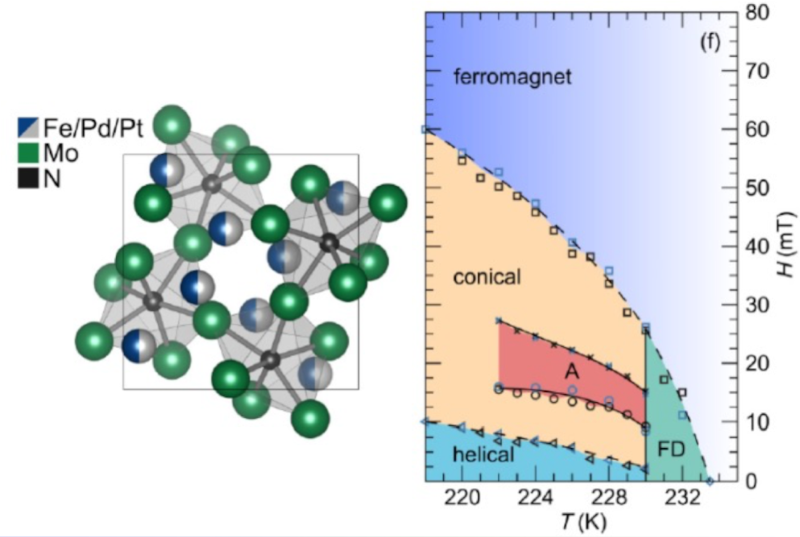
After discovering a new magnetic host of skyrmion states, UC Santa Barbara IRG-1 researchers were able to show that chemically alloying the compound FePd1−xPtxMo3N allows for the size of the skyrmion defects to be controlled while still preserving their stability. Skyrmion states are broadly sought in new materials due to their potential uses in low power memory devices and other spin-based electronics.
 Download
Materials Research Science and Engineering Center at UCSB
The U.S. National Science Foundation Materials Research Science and Engineering Center at UC Santa Barbara develops and sustains a productive, collaborative, and engaged community that drives a portfolio of transformative materials research and empowers a diverse workforce.