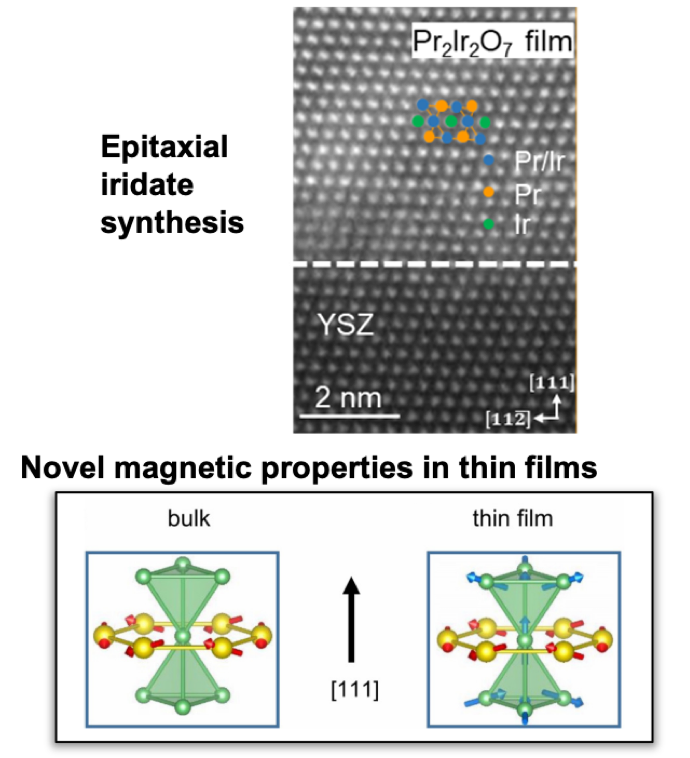
 The magnetism of materials arises from magnetic moments associated with particular atoms. A magnetic moment is a bit like a tiny bar magnet. If all the moments point in the same direction, the material behaves like a permanent magnet, but there are many other possible arrangements with different behaviors.
The Wisconsin MRSEC has created thin films of a fascinating magnetic material, Pr2Ir2O7, in which the magnetic moments are frustrated: No matter how they are arranged, some of the moments are always fighting to change their direction, like two bar magnets with their north poles shoved together. Frustration creates a rich landscape for discovery and manipulation of new magnetic effects and of electronic phenomena linked to magnetism.
The Pr2Ir2O7 was synthesized by solid-phase epitaxy, a process in which a structurally disordered, amorphous layer is transformed into an ordered crystal. This synthesis method avoids evaporation of iridium during crystal growth, which limits synthesis by conventional methods. A key feature of the thinness of the films is that they are stretched during growth, which provide further control of their magnetic properties.
 Download

Wisconsin Materials Research Science and Engineering Center
The U.S. National Science Foundation-sponsored Wisconsin Materials Research Science and Engineering Center brings together teams of researchers from diverse disciplinary backgrounds to tackle grand challenges in the materials science of liquids and glasses and non-equilibrium magnetism.