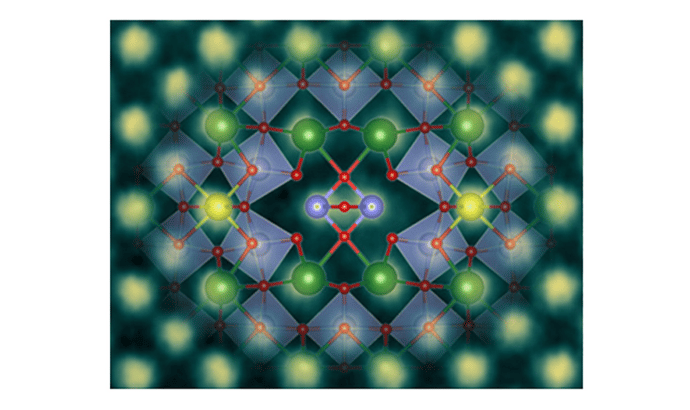
Semiconductors, which have electrical properties in between metals and insulators, are the building blocks of devices like transistors that fuel computer technology. New semiconducting materials that could outperform existing ones are continuously sought in science and engineering, with oxides being one contender. In recent work in the University of Minnesota MRSEC, researchers studying one such oxide semiconductor - barium tin oxide - made the startling discovery of a completely new type of “line defect”. Defects are common in semiconductors, in some cases being required for their operation, but this defect essentially forms an electrically conductive “defect wire” in the semiconducting material, which is extremely unusual. Such defects open up exciting new possibilities in terms of controlling the one dimensional motion of electrons in semiconductors, potentially leading to new types of electronic devices.
 Download
UMN Materials Research Science and Engineering Center (2020)
This multifaceted NSF MRSEC enables important areas of future technology, ranging from applications of electrical control over materials to scale-invariant shape-filling amphiphile network self-assembly. The UMN MRSEC manages an extensive program in education and career development. The MRSEC is bolstered by a broad complement of over 20 companies that contribute directly to IRG research through intellectual, technological, and financial support. International research collaborations and student exchanges are pursued with leading research labs in Asia and Europe.