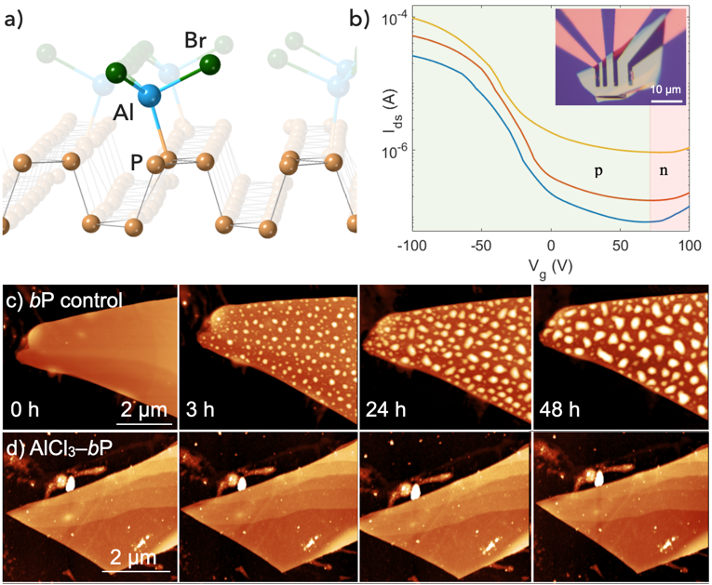
 We have developed a solution-phase protocol to modify the Lewis basic surface of few-layer black phosphorus (bP) using commercially available Lewis acids, and demonstrated its effectiveness at providing outstanding ambient stability and tuning of electronic properties.
The intrinsic programmability and discrete molecular nature of Lewis acids (e.g., AlBr3) offers a unique opportunity for deliberate, selective tuning of surfaces. From a practical standpoint, it is noteworthy that the Lewis acids are commercially available and the protocol is compatible with bP incorporation into devices, greatly reducing the complexity of their fabrication. We envision that this simple yet effective protocol could be extended to other 2D materials and will be easily incorporated in the fabrication of composite, complex devices at the manufacturing stages, providing solutions currently nonexistent with traditional methods.
MEM-Seed
 Download

University of Washington Molecular Engineering Materials Center
The University of Washington Molecular Engineering Materials Center, an NSF MRSEC, executes fundamental materials research that aims to push the frontiers of science and accelerate the emergence of future advanced technologies.