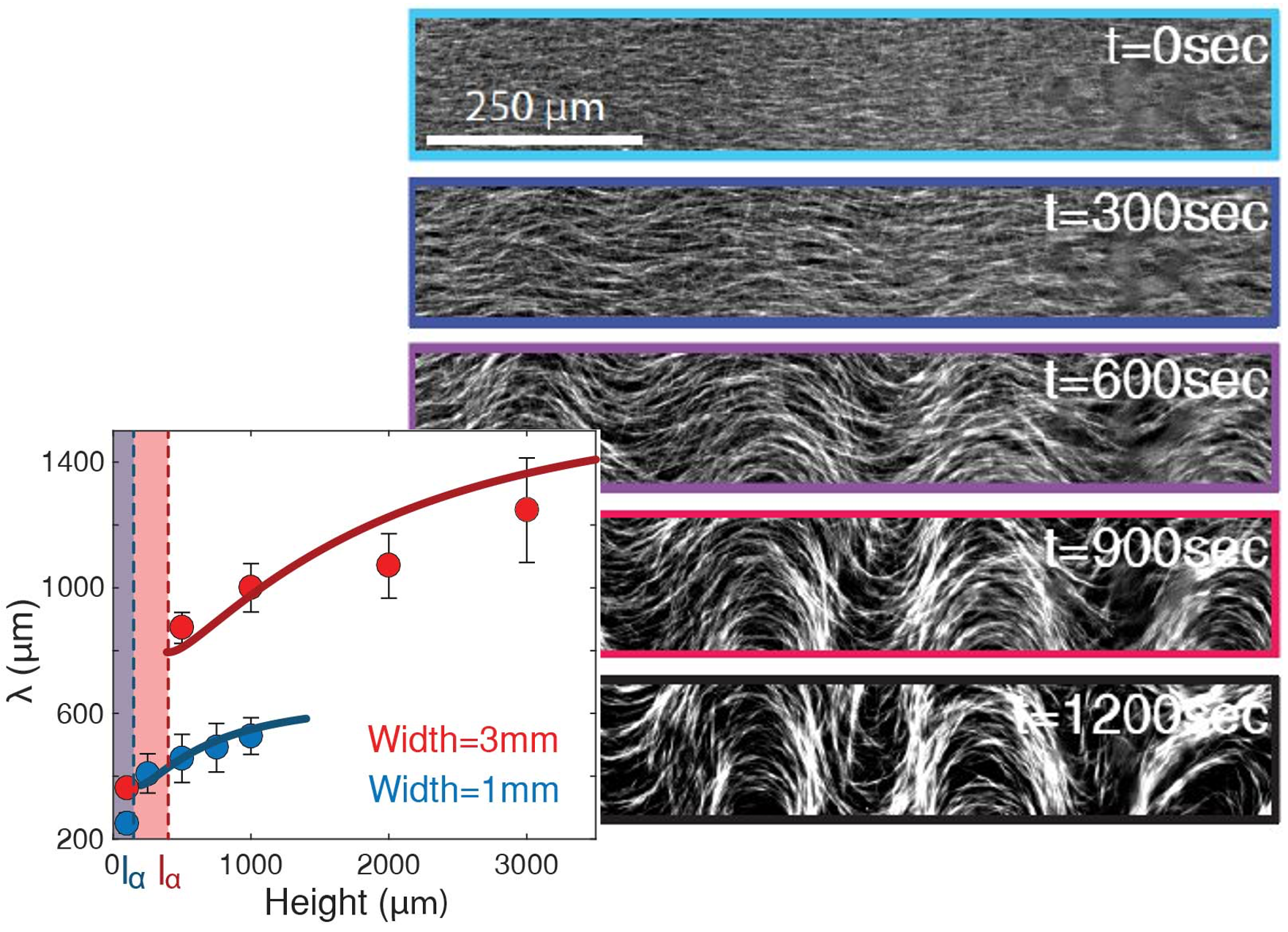
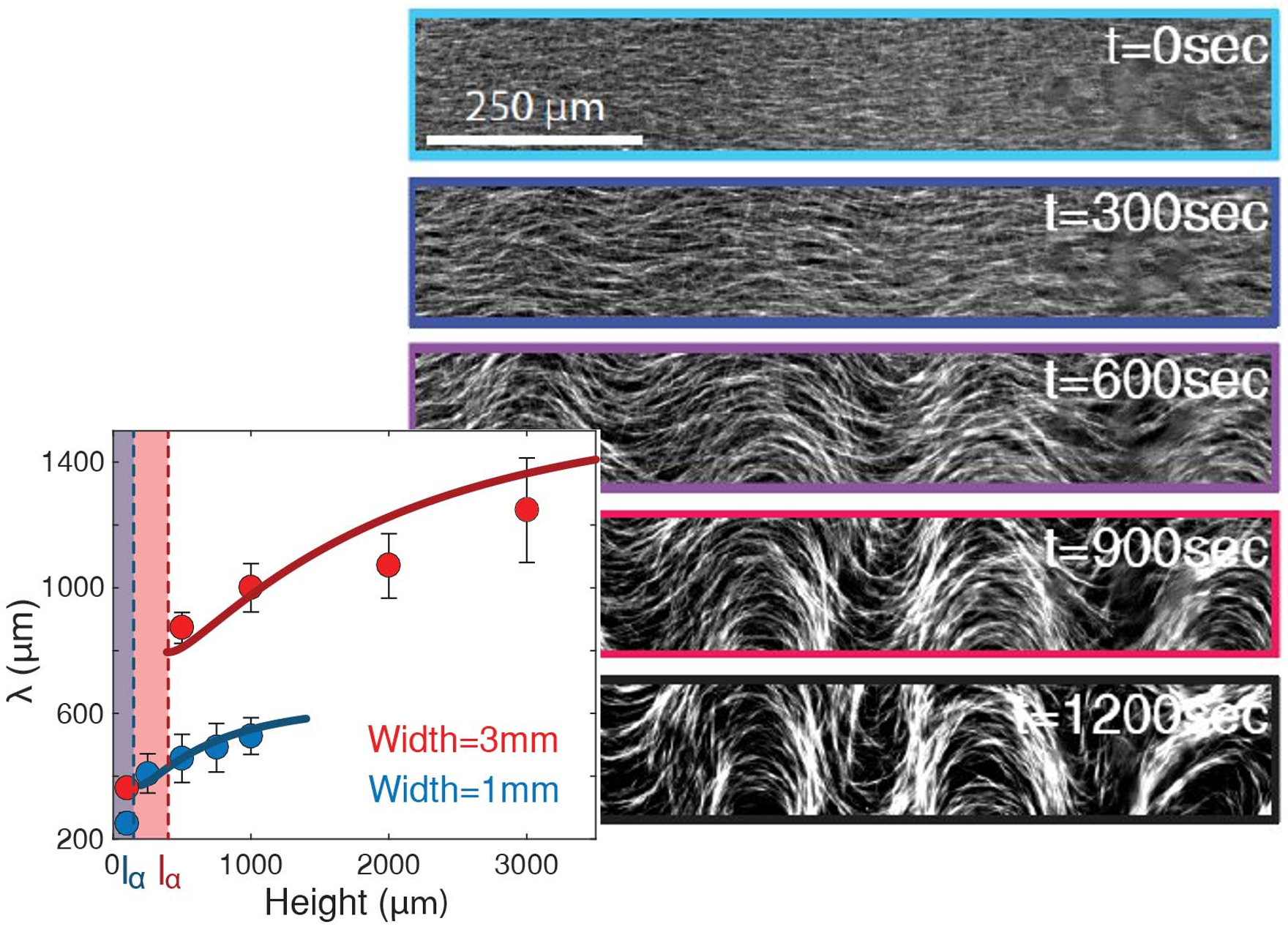
 Spontaneous growth of long-wavelength deformations is a defining feature of active fluids with orientational order. In particular, for unconfined extensile active nematics, minimal hydrodynamic models predict that the fastest-growing deformation has an infinite wavelength. Here [1], three IRG2 PP developed a combination of experiments with 3D active fluids confined in microfluidic channels and a minimal hydrodynamic model to show that size of the channel determines the emergent lengthscale of the growing deformations. These findings will advance our understanding of active nemato-hydrodynamics and the pathways to 3D active turbulence at low Reynolds number.
[1] Chandrakar, Varghese, Baskaran, Dogic, and Duclos, Phys. Rev. Lett. 125, 257801
 Download
.png/thumbcontain)
The Bioinspired Soft Materials Center (2020)
The Brandeis Materials Research Science and Engineering Center (MRSEC) seeks to create new materials that are constructed from only a few simplified components, yet capture the remarkable functionalities found in living organisms.