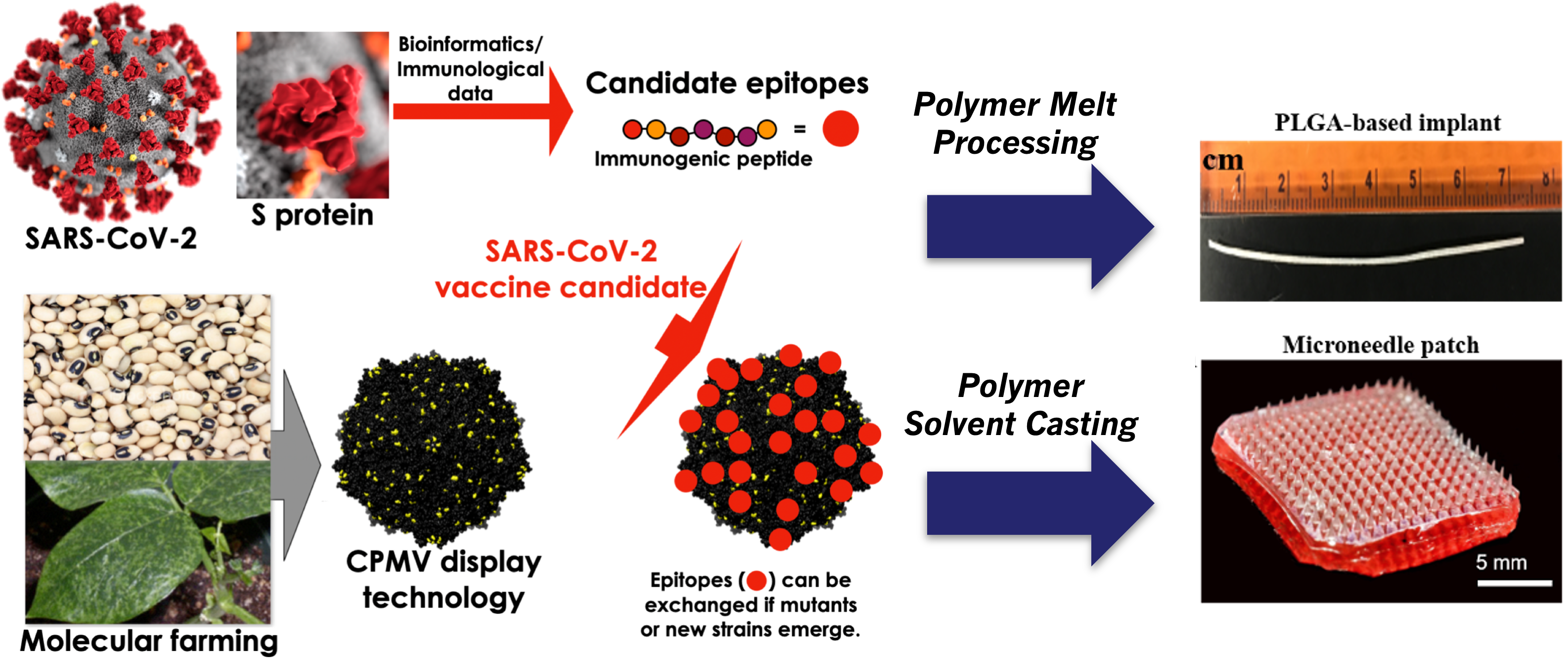
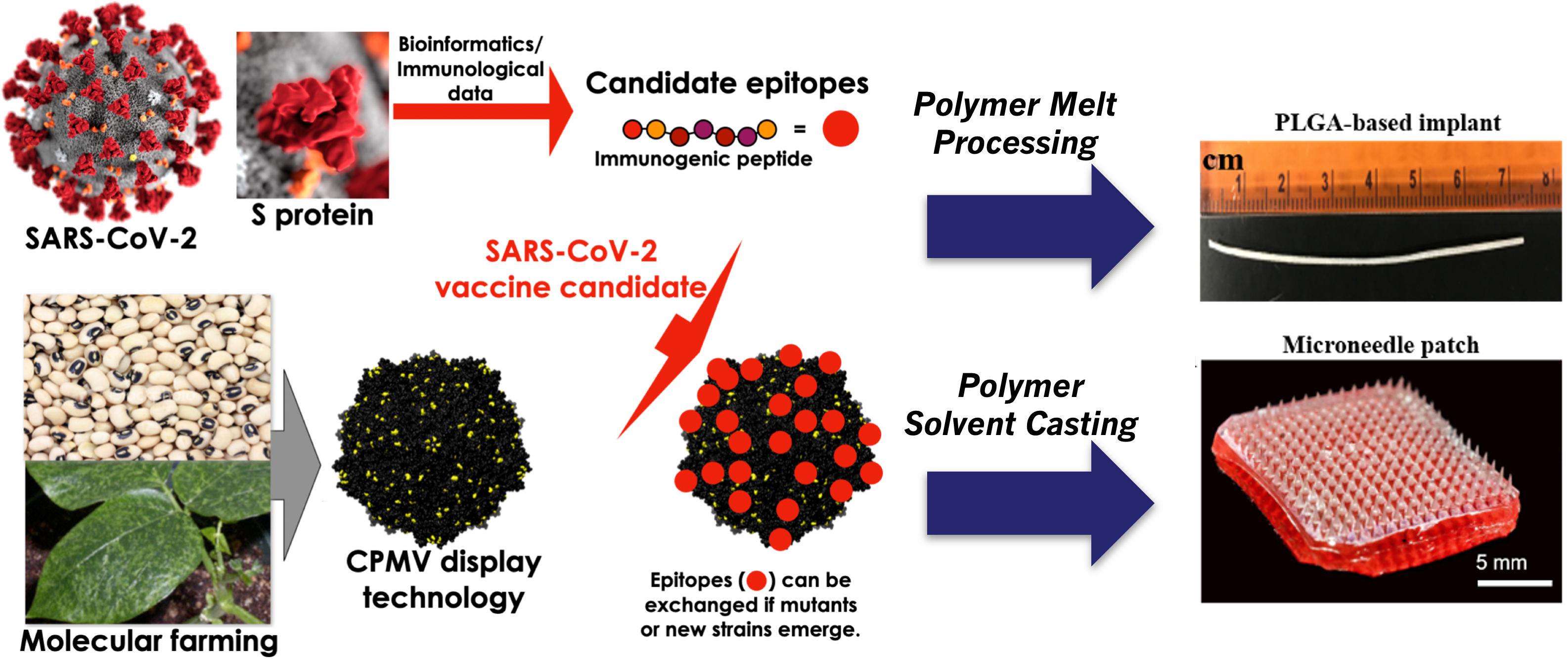
 The COVID-19 pandemic highlights the need for platform technologies enabling rapid development of vaccines for emerging viral diseases. The current vaccines target the SARS-CoV-2 spike (S) protein and thus far have shown tremendous efficacy. However, the need for cold-chain distribution, a prime-boost administration schedule, and the emergence of variants of concern (VOCs) call for diligence in novel SARS-CoV-2 vaccine approaches. We studied 13 peptide epitopes from SARS-CoV-2 and identified three neutralizing epitopes that are highly conserved among the VOCs. Monovalent and trivalent COVID-19 vaccine candidates were formulated by chemical conjugation of the peptide epitopes to cowpea mosaic virus (CPMV) nanoparticles and virus-like particles (VLPs) derived from bacteriophage Qβ. Efficacy of this approach was validated first using soluble vaccine candidates as solo or trivalent mixtures and subcutaneous prime-boost injection. The high thermal stability of our vaccine candidates allowed for formulation into single-dose injectable slow-release polymer implants, manufactured by melt extrusion, as well as microneedle (MN) patches, obtained through casting into micromolds, for prime-boost self-administration. Immunization of mice yielded high titers of antibodies against the target epitope and S protein, and data confirms that antibodies block receptor binding and neutralize SARS-CoV and SARS-CoV-2 against infection of human cells. We present a nanotechnology vaccine platform that is stable outside the cold-chain and can be formulated into delivery devices enabling single administration or self-administration. CPMV or Qβ VLPs could be stockpiled, and epitopes exchanged to target new mutants or emergent diseases as the need arises.
 Download
UC San Diego MRSEC (2020)
The UC San Diego Materials Research Science and Engineering Center fosters research, education, and outreach across the disciplines of engineering, physical sciences, and biological sciences, with a focus on new materials and new materials properties.