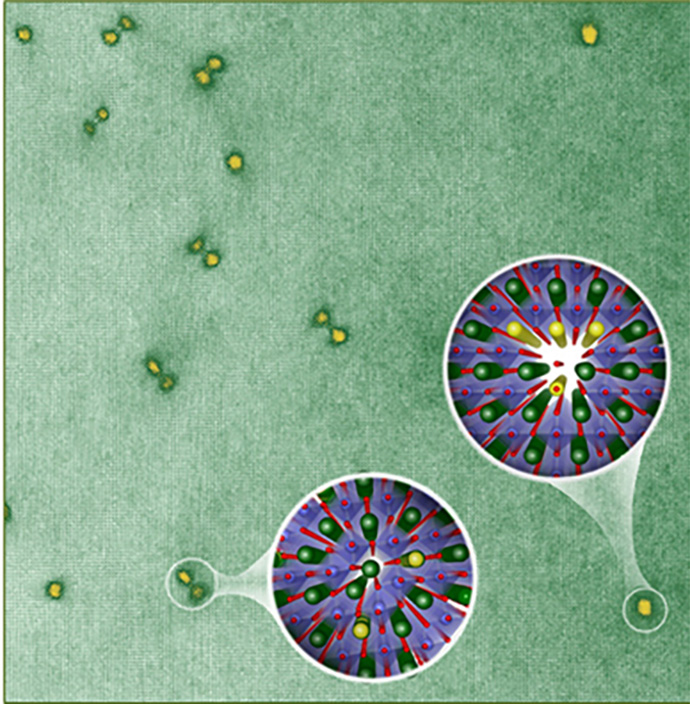
Emerging semiconductors such as tin-based oxides have enormous application potential in devices, as they are transparent, support highly mobile electrons, and have wide “energy gaps”. Unlike better developed semiconductors, however, these materials are prone to harboring defects, which can limit essential properties such as electron mobility. In this work, University of Minnesota MRSEC researchers achieved the first detailed understanding of the interactions between the most important defects in these materials: deliberately-introduced “dopant” atoms, and naturally-forming “dislocations” (essentially extra chains of atoms). The dislocations were found to profoundly impact dopant atom locations, the formation of additional defects, and the electronic properties of the semiconductor, in unexpected ways. These results will now inform future studies to further refine the electronic properties of these exciting new materials.
 Download
UMN Materials Research Science and Engineering Center (2020)
This multifaceted NSF MRSEC enables important areas of future technology, ranging from applications of electrical control over materials to scale-invariant shape-filling amphiphile network self-assembly. The UMN MRSEC manages an extensive program in education and career development. The MRSEC is bolstered by a broad complement of over 20 companies that contribute directly to IRG research through intellectual, technological, and financial support. International research collaborations and student exchanges are pursued with leading research labs in Asia and Europe.