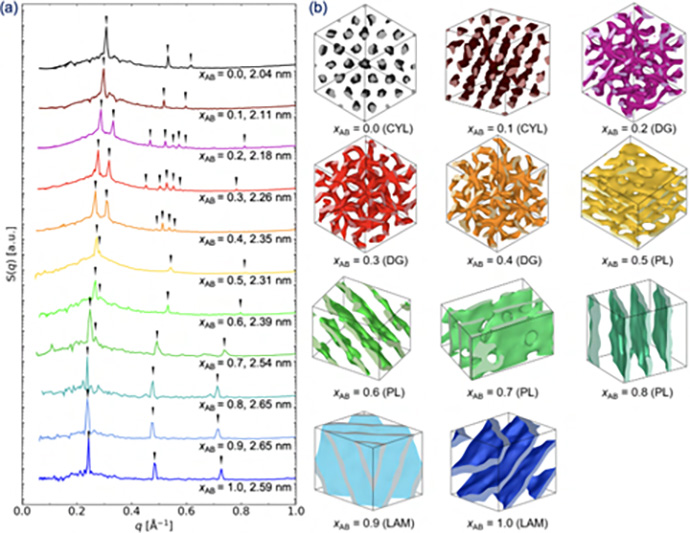
Based on the hypothesis that blending LAM- and CYL-forming block oligomers may yield stable network phases, molecular dynamics simulations are used to study binary blend self-assembly of AB-type diblock (n-tridecan-1,2,3,4-tetraol) and AB2-type miktoarm (5-octyl-tridecan-1,2,3,4-tetraol) amphiphiles. The AB2-rich and AB-rich blends form double gyroid (DG) networks and perforated lamellae (PL), respectively. Structural analyses reveal that the non-constant interfacial curvatures of DG and PL structures are supported by local composition variations of the LAM- and CYL-forming amphiphiles.
Comparisons to self-consistent mean-field theory calculations reveal self-assembly differences and similarities between block copolymer blends and stiffer, H-bonding oligomer mixtures, suggesting new design principles for tuning shape-filling oligomer and polymer architectures to achieve wide stability windows for network phases.
 Download
UMN Materials Research Science and Engineering Center (2020)
This multifaceted NSF MRSEC enables important areas of future technology, ranging from applications of electrical control over materials to scale-invariant shape-filling amphiphile network self-assembly. The UMN MRSEC manages an extensive program in education and career development. The MRSEC is bolstered by a broad complement of over 20 companies that contribute directly to IRG research through intellectual, technological, and financial support. International research collaborations and student exchanges are pursued with leading research labs in Asia and Europe.