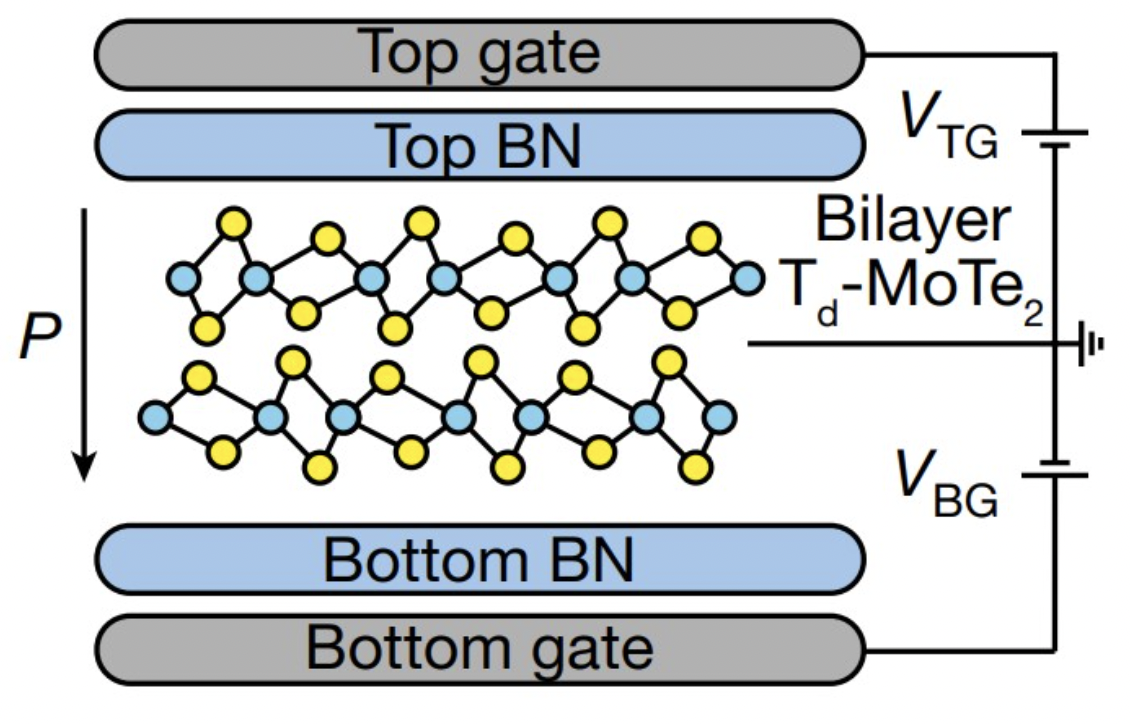
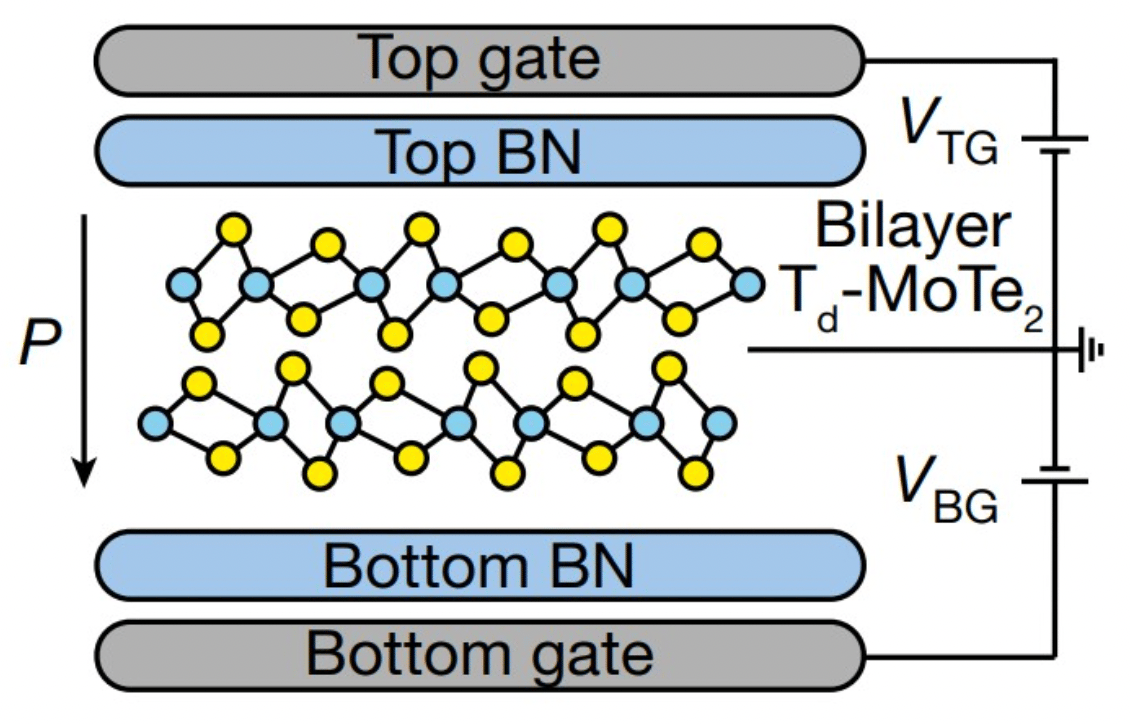
 For the first time, a team comprised of two IRG-1 theorists (Birol and Fernandes) working with experimentalists from other institutions (including the Columbia MRSEC) showed the coexistence of ferroelectricity (i.e., electrostatically switchable macroscopic dipole moment) and superconductivity in a two-dimensional superconductor. The material is bilayer MoTe2, a member of the family of transition metal dichalcogenides, which are compounds of high interest in IRG-1. This important result opens a new avenue to the control of superconductivity by electrostatic means. The IRG-1 team’s theoretical approach combined first-principles and model calculations. Theoretical calculations were performed by IRG-1 student Amartyajyoti Saha. The theoretical analysis attributes the unique superconducting behavior of MoTe2 as a function of gating to an unconventional pairing state, thus shedding new light on the phenomenon of superconductivity in two-dimensional materials, of broad interest.
 Download
UMN Materials Research Science and Engineering Center (2020)
This multifaceted NSF MRSEC enables important areas of future technology, ranging from applications of electrical control over materials to scale-invariant shape-filling amphiphile network self-assembly. The UMN MRSEC manages an extensive program in education and career development. The MRSEC is bolstered by a broad complement of over 20 companies that contribute directly to IRG research through intellectual, technological, and financial support. International research collaborations and student exchanges are pursued with leading research labs in Asia and Europe.