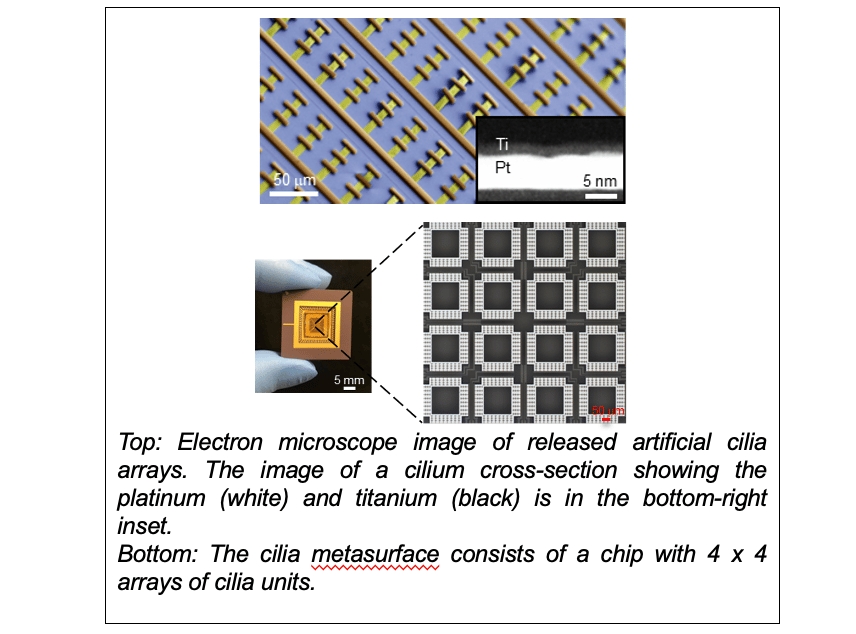
Many organisms use cilia to control fluids at the microscale. Engineering a cilia platform with comparable capabilities, however, has remained elusive. Now, Cornell researchers have taken a step towards such systems by creating electronically-actuated artificial cilia that can create arbitrary flow patterns in liquids near a surface. The team first created voltage-actuated cilia that can drive surface flows at tens of microns per second with only 1 volt applied. In a second demonstration, they fabricated robotic cilia that can be controlled locally to generate and switch between desired surface flow patterns. Finally, they integrated the cilia with a light-powered clock circuit on a chip and demonstrated wireless operation. With this circuit the team was able to drive the cilia in the wave-like pattern that is characteristic of natural cilia and underlies their efficiency. These results, demonstrated experimentally and confirmed using theoretical computations, illustrate a new pathway to microfluidic manipulations, with applications that include microfluidic pumping and microrobotic locomotion.
 Download