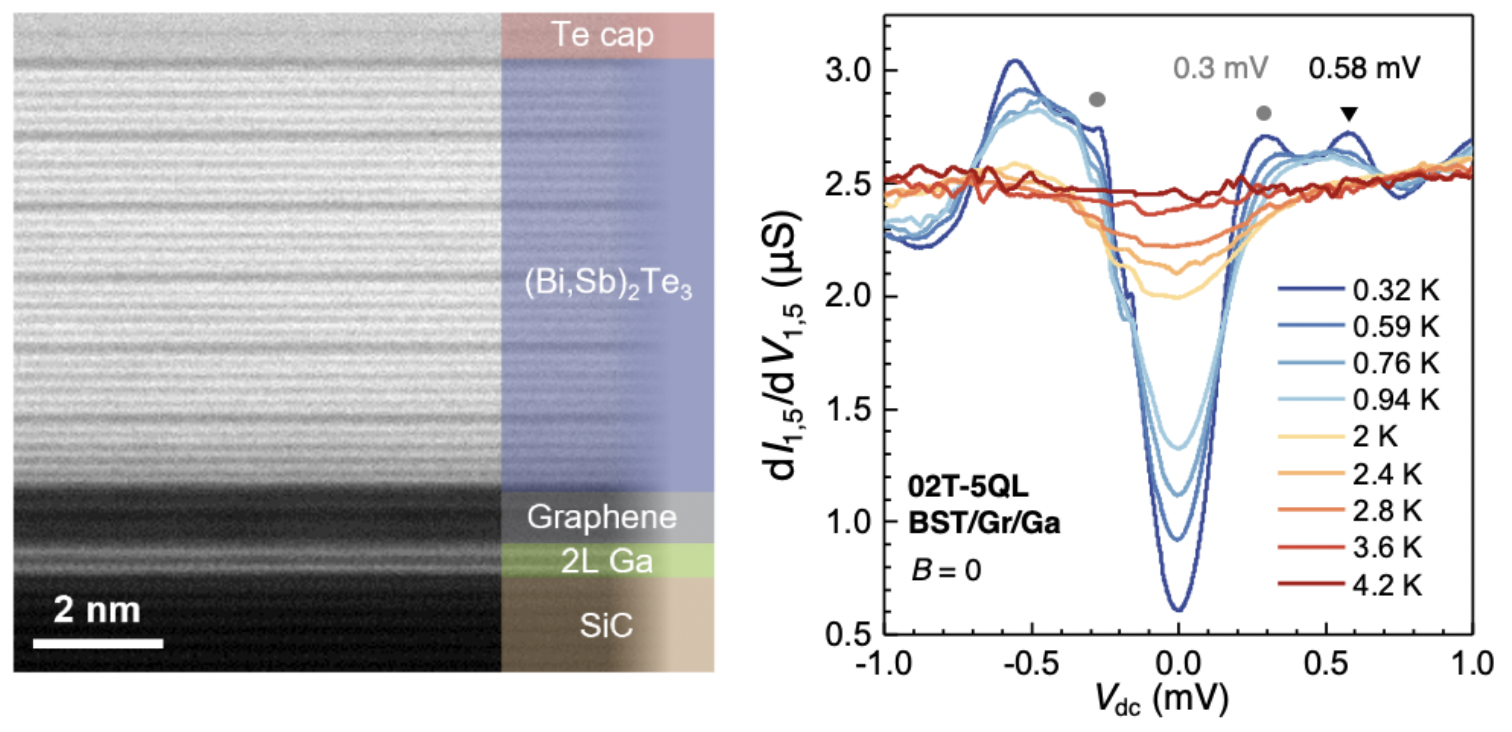
 The search for an unusual form of superconductivity known as topological superconductivity has attracted a great deal of attention of the quantum materials community because of its fundamental novelty and potential applications in fault-tolerant quantum computing technology. A hybrid structure of a topological insulator and an s-wave superconductor is expected to host topological superconductivity. A thin-film material platform is particularly useful in building devices and device applications.
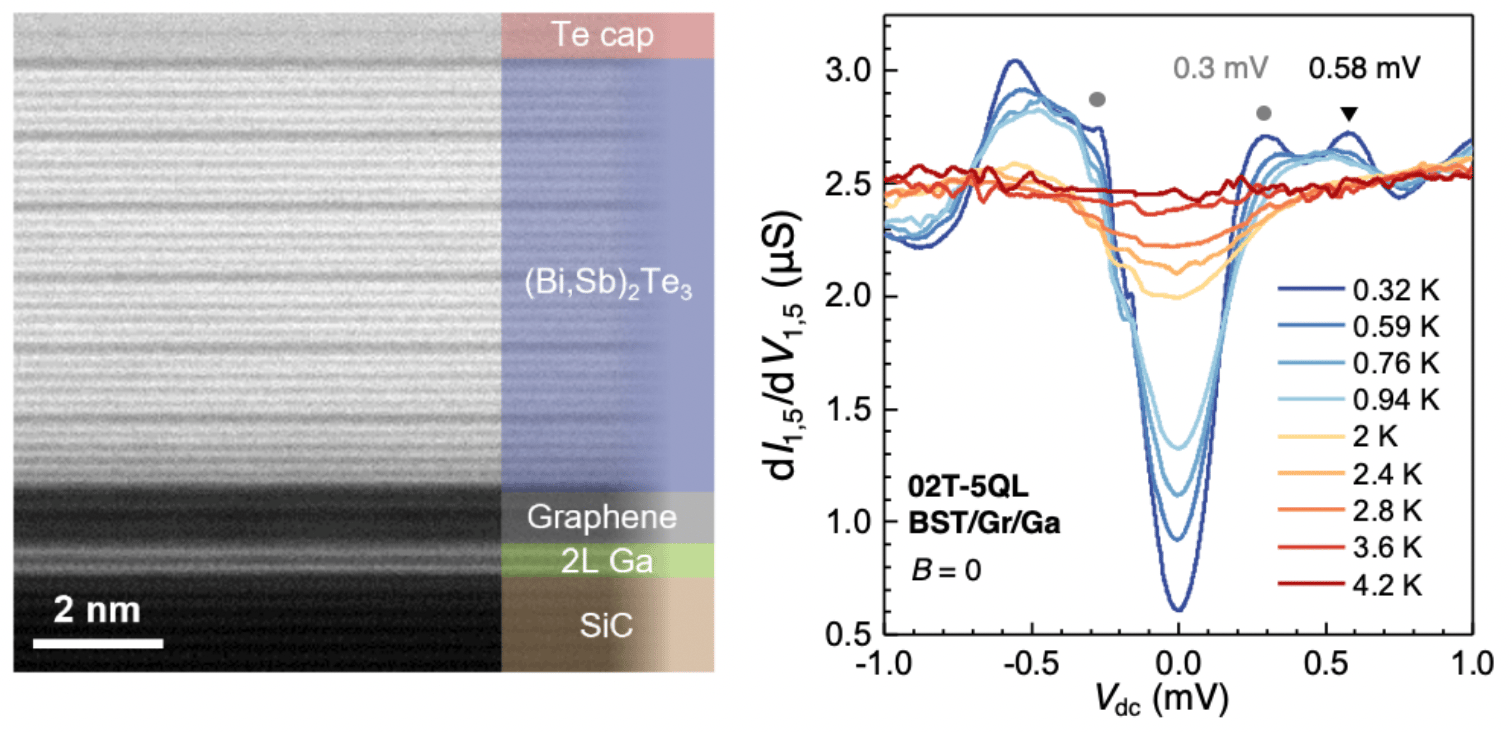
An IRG team has developed a new synthetic approach to overcome prior growth challenges to realize a thin-film topological insulator/superconductor hybrid structure. This approach produced high-quality epitaxial (Bi,Sb)2Te3/graphene/two-atomic-layer gallium heterostructures with atomically abrupt interfaces that shows robust proximity-induced superconductivity in the Dirac surface states of the (Bi,Sb)2Te3film, thus fulfilling a necessary step to the creation of a topological superconductor. This work paves the path to explorations of topological superconductivity and quantum computing circuitry in a scalable material platform.
 Download
Penn State Center for Nanoscale Science (2020)
The Center for Nanoscale Science supports collaborative, interdisciplinary research efforts on nanoscale materials. Principal research activities are organized into two interdisciplinary research groups: 2D Polar Metals & Heterostructures and Crystalline Oxides with High Entropy. Center-initiated programs encourage collaborative partnerships with science museums and non-R1 universities as well as engagement in outreach, education, and workforce development initiatives.