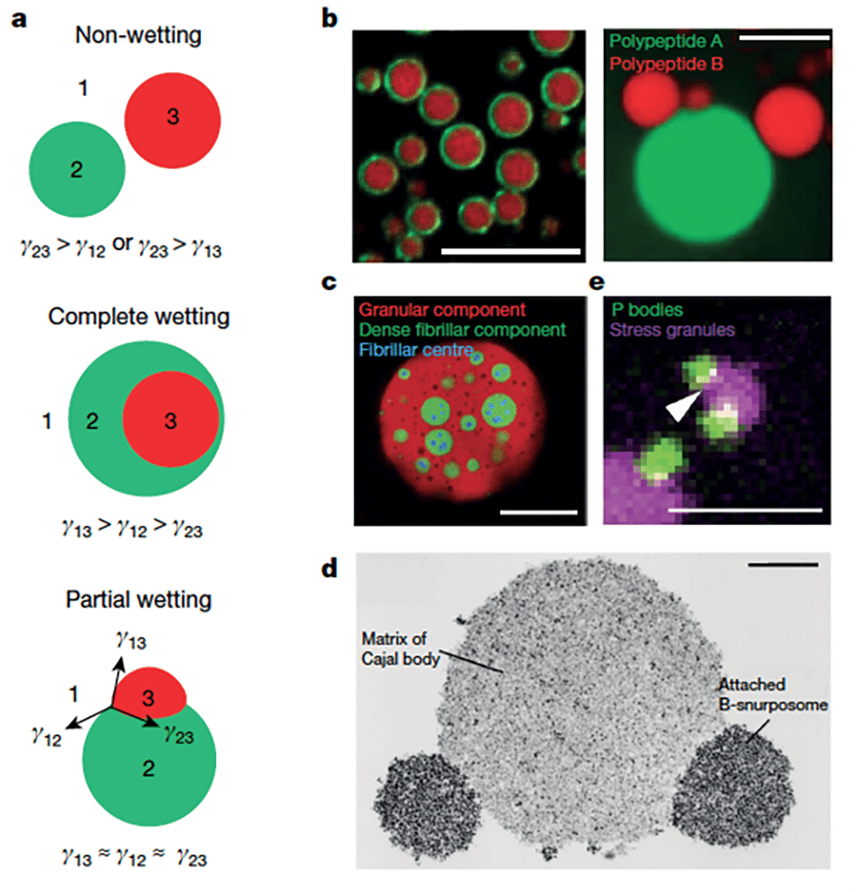
The intracellular environment is a complex and crowded sea of biomolecules, buffeted by incessant motion from Brownian thermal fluctuations and biological activity. Cellular function is achieved by bringing order to this environment, in large part through sub-compartmentalization into a spatially controlled and compositionally defined organization. Historically, these compartments were thought of almost exclusively as membrane-bound structures, but recent work has highlighted the importance of membraneless organelles, also known as biomolecular condensates, which form through phase transitions, including liquid–liquid phase separation. Some of the dozens of examples of such protein and nucleic acid-rich condensates include P granules, nucleoli, stress granules, the pyrenoid and DNA repair foci.
 Download

Princeton Center for Complex Materials (2020)
Established in 1994, the Princeton Center for Complex Materials is dedicated to exploring the frontiers of complexity in materials science. The Center supports two IRGs that will accelerate exploration of quantum technologies and biology-inspired materials.