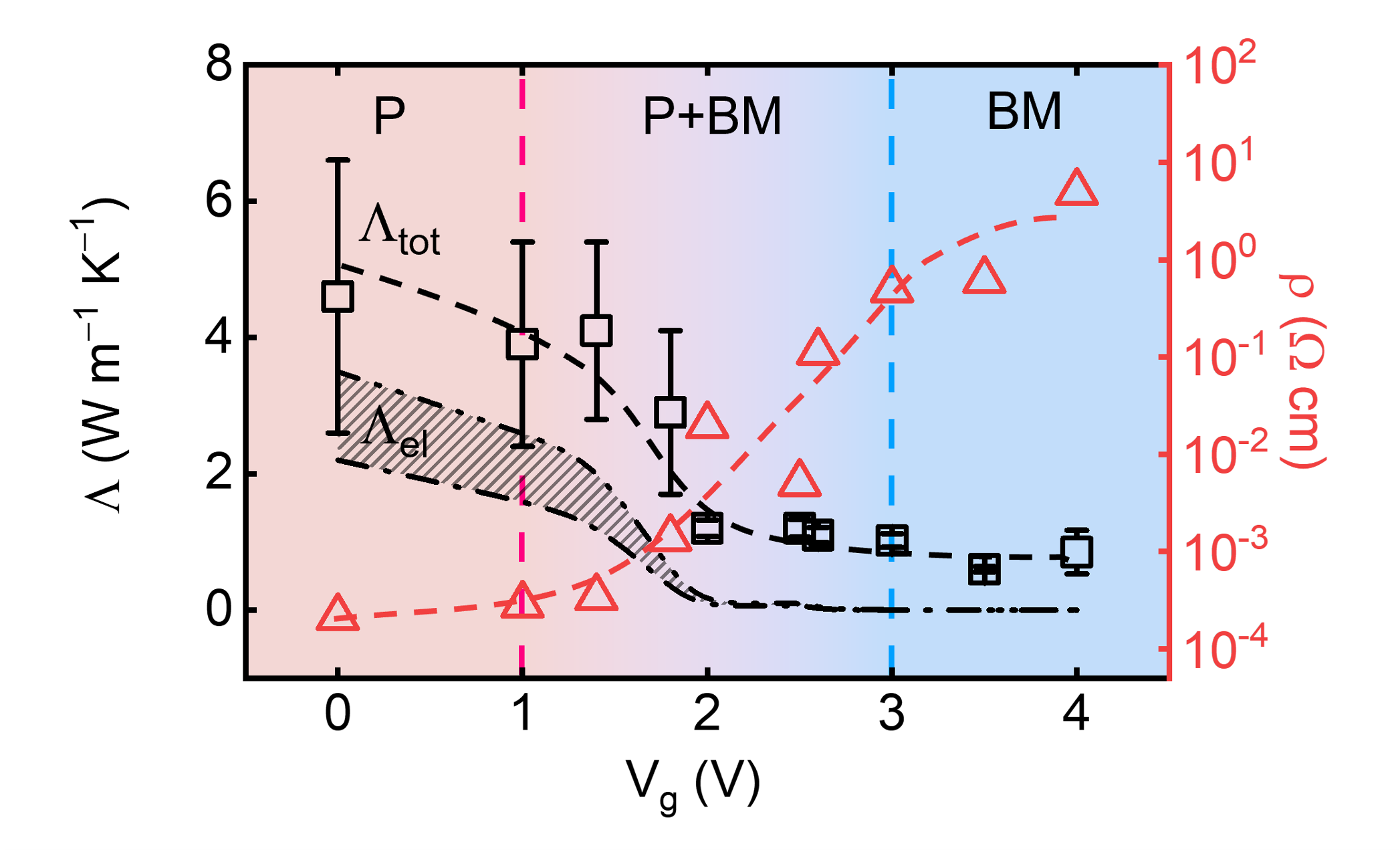
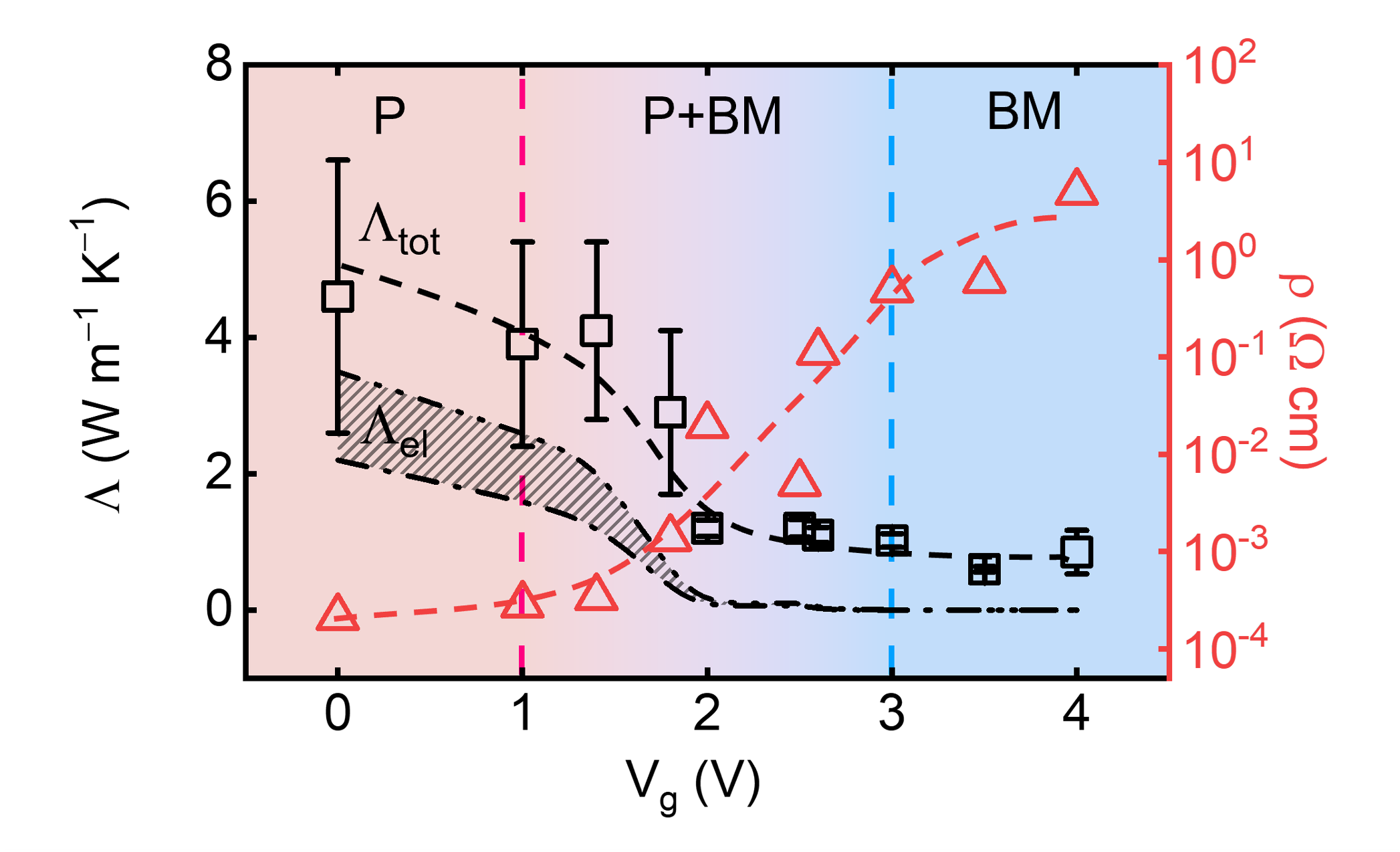
 A team from IRG-1, working with collaborators at Argonne National Laboratory and the University of Utah, have demonstrated continuous room-temperature electrical tuning of the thermal conductivity of La0.5Sr0.5CoO3-d by a factor of more than five (a record for a single-step process) via ion-gel gating. Application of a gate voltage in these devices drives a transformation from a metallic perovskite phase to an insulating brownmillerite phase via the formation and migration of oxygen vacancies, realizing the record range of measured thermal conductivities. The ability to control thermal conductivity electrically with a small voltage at room temperature is important for thermal regulation and management in several emergent device concepts.
The team’s approach used a combination of methods, including time-domain thermoreflectance, electronic transport, and X-ray diffraction at the Advanced Photon Source, Argonne National Laboratory, to measure and understand the mechanisms that enable this record tuning of the thermal conductivity.
 Download
UMN Materials Research Science and Engineering Center (2020)
This multifaceted NSF MRSEC enables important areas of future technology, ranging from applications of electrical control over materials to scale-invariant shape-filling amphiphile network self-assembly. The UMN MRSEC manages an extensive program in education and career development. The MRSEC is bolstered by a broad complement of over 20 companies that contribute directly to IRG research through intellectual, technological, and financial support. International research collaborations and student exchanges are pursued with leading research labs in Asia and Europe.