The phase behavior of polymers in solution is of both fundamental and practical interest. Previous work using coarse-grained molecular simulations suggests that the critical temperature (Tc) of macromolecules in solution can be controlled by monomer sequence.
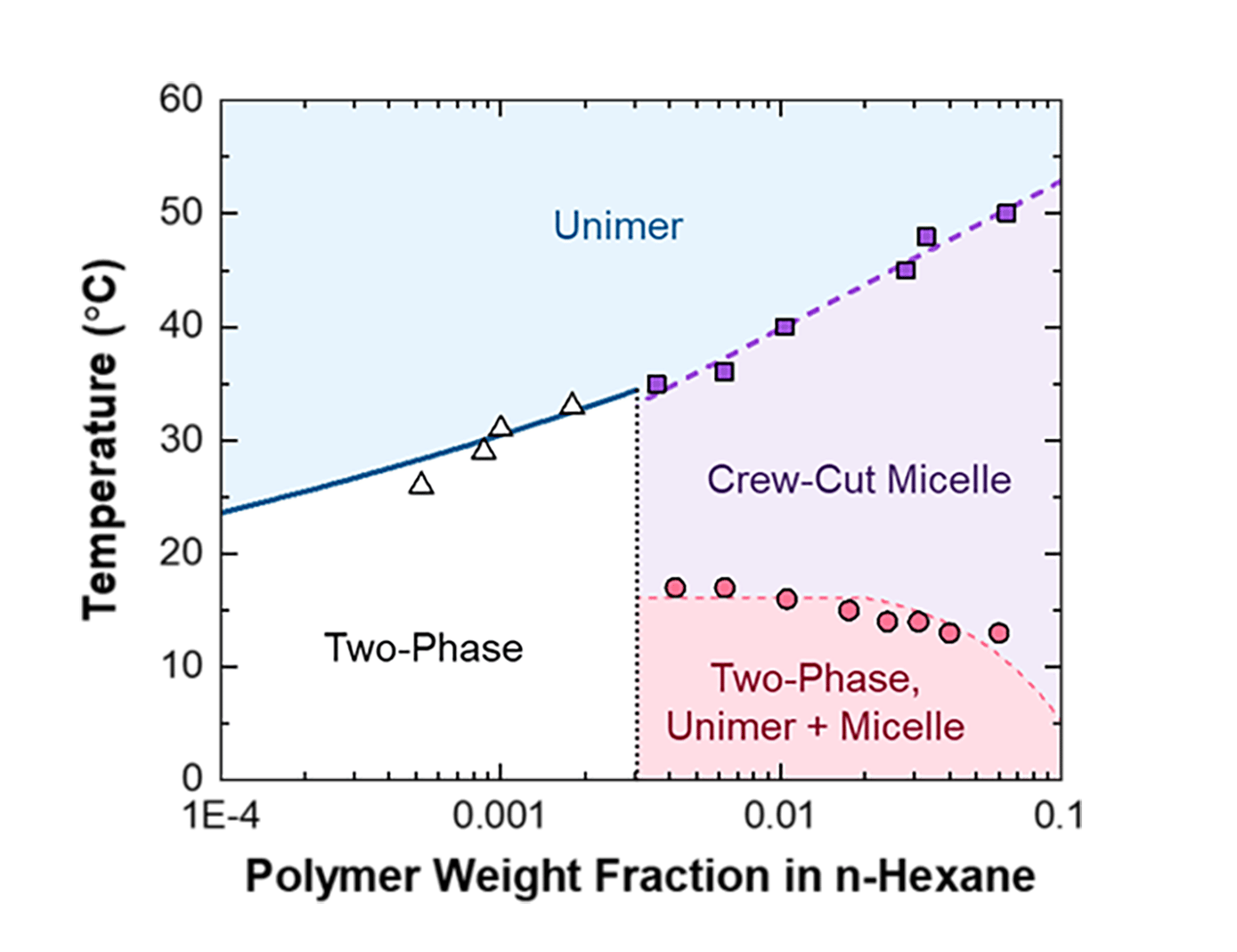
Here, the researchers from Princeton's IRG-B group experimentally investigated the solution phase behavior of a series of styrene-isoprene copolymers in both styrene- and isoprene-selective solvents. Across the series, the copolymers had similar overall composition and molecular weight, but subtle changes in monomer sequence obtained by systematically placing a short homopolymer block of either polystyrene or polyisoprene at the end or the center of an otherwise random styrene-isoprene copolymer chain. Compared with a fully-random copolymer, sequences that microphase-separate to form star-like or crew-cut micelles produce a lower Tc. Conversely, sequences that do not form micelles exhibit a higher Tc. Through a delicate balance of solvent/polymer compatibility, the team demonstrates the spontaneous and thermoreversible formation of unusually large (aggregation number ~1000), stable crew-cut micelles. Despite the unusual structure, the thermodynamics of formation of these crew-cut micelles are similar to those of star-like block copolymer micelles.
Macromolecules 57, 3, 916–925 (2024) (ASAP Article)
DOI: https://doi.org/10.1021/acs.macromol.3c02111
 Download
Control of Solution Phase Behavior through Block–Random Copolymer Sequence
Princeton Center for Complex Materials (2020)
Established in 1994, the Princeton Center for Complex Materials is dedicated to exploring the frontiers of complexity in materials science. The Center supports two IRGs that will accelerate exploration of quantum technologies and biology-inspired materials.